This index serves as a complete directory of the artists held in our collection. Browse by name to access their historical context and view a dedicated survey of their works.
Artists
Loading artists…
Wassily Kandinsky
Russian, 1866–1944
Russian painter and art theorist, widely credited as one of the pioneers of abstract art. He co-founded Der Blaue Reiter in Munich in 1911, taught at the Bauhaus from 1922 to 1933, and spent his final years in Paris. His theoretical writings — especially Concerning the Spiritual in Art (1911) — argued that color and form could express inner states directly, without representational subject matter.
Arthur Dove
American, 1880–1946
Often called the first American abstract painter, though he never fully let go of the natural world — you can almost always find a landscape buried in his work. He worked on Long Island for much of his life, and his paintings tend to feel like the rural Northeast filtered through a long familiarity with it.
Harry Aiken Vincent
Alphonse Osbert
French, 1857–1939
French Symbolist painter associated with the Rosicrucian circle around Joséphin Péladan in the 1890s. He adopted a Pointillist technique from Seurat and Signac in the late 1880s, and used it to build atmospheric, near-monochromatic landscapes — golds, tans, and muted lavenders, with water and sky often nearly indistinguishable from each other.
Roderic O'Conor
Irish, 1860–1940
Irish Post-Impressionist painter who spent most of his career in France, where he was close friends with Gauguin at Pont-Aven in the 1890s. He never exhibited with the Impressionists or any formal group, and his work — built in thick, striated brushstrokes of saturated color — was largely unknown in Ireland and England during his lifetime.
Alfred Wallis
George Inness
American, 1825–1894
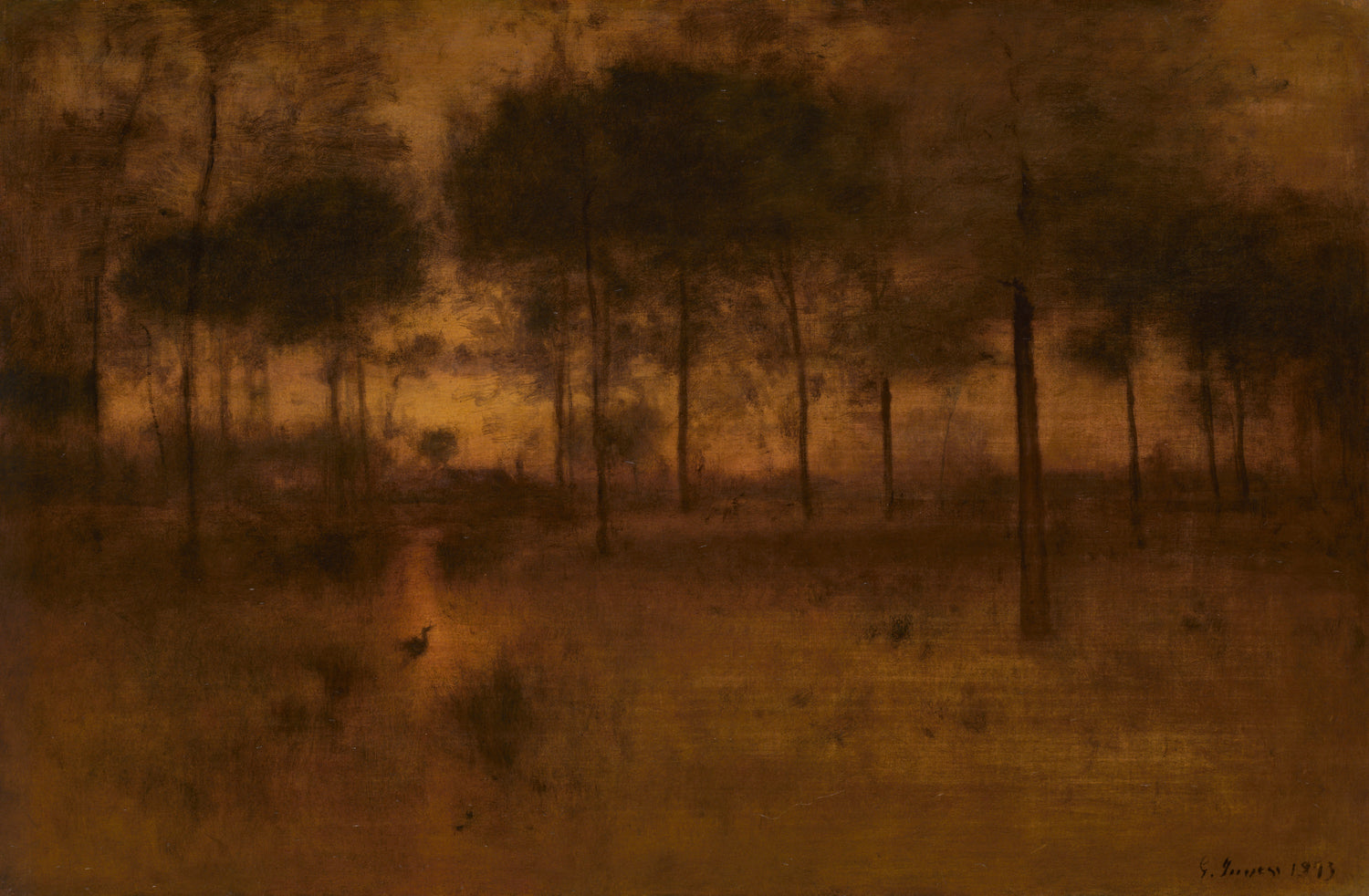
One of the most influential American landscape painters of the nineteenth century, associated first with the Hudson River School and later with a more personal, atmospheric style influenced by the Barbizon painters and by the theology of Emanuel Swedenborg. He believed painting should convey spiritual states through landscape, and his late work moved increasingly toward soft, dissolved forms and tonal unity.
Otto Marseus van Schrieck
Dutch, 1619–1678
Dutch Golden Age painter who invented the sottobosco genre — dark, atmospheric paintings of forest floors teeming with snakes, insects, fungi, butterflies, and thistles. He kept live reptiles and insects in his garden near Florence specifically to study and paint them. His contemporaries called him "Snuffelaer" (the sniffer) for his habit of crawling through undergrowth looking for specimens.
Paul Klee
German, 1879–1940
Swiss-German painter and Bauhaus teacher whose work moved fluidly between Expressionism, Cubism, and Surrealism without ever fully belonging to any of them. He believed art should make the invisible visible, and his small-scale paintings — often built from grids of color, hieroglyphs, and floating forms — have a deceptive simplicity that masks decades of theoretical thinking. He taught at the Bauhaus from 1921 to 1931 alongside Kandinsky, and was dismissed from his subsequent post in Düsseldorf when the Nazis came to power.
Jankel Adler
Polish, 1895–1949
Polish-Jewish painter who co-founded the Yung-Yidish group of artists in Łódź, studied with Paul Klee in Düsseldorf, and met Picasso in Paris. Forced to flee Germany in 1933 when his work was declared degenerate, he volunteered for the Polish army in 1939 and spent his last years in England — painting with the knowledge that his entire family in Poland had been killed.
Alfred Henry Maurer
American, 1868–1932
American painter and the youngest of the founding members of the Taos Society of Artists. He grew up on a farm in Shelbyville, Indiana, and left for Chicago at fifteen to study at the Art Institute of Chicago, supporting himself as a sign painter and scenic decorator. In 1911 he traveled to Europe, studying in Munich, Paris, and London for two years. On his return to Chicago in 1914, his patron Carter Harrison sent him and fellow painter Walter Ufer to Taos, New Mexico for a year in exchange for paintings. Higgins never left. Along with Ernest Blumenschein, he was the most formally experimental of the Taos artists, moving from academic realism toward a compressed, Cubist-influenced treatment of the New Mexico landscape after encountering Andrew Dasburg and John Marin in Taos. He won prizes steadily through the 1920s, was elected to the National Academy in 1921, and exhibited at the Venice Biennale and the Luxembourg in Paris. In his final years he painted a series of small plein air canvases he called "Little Gems," working from a setup in the trunk of his car. Blumenschein considered them among his best work.
Edward Steichen
(American, 1879–1973)
Steichen born in Luxembourg and emigrated to the United States as an infant, growing up in Milwaukee. He began a lithography apprenticeship at fifteen and taught himself painting at the Milwaukee Art Students' League before picking up a camera. In 1900, on his way to study painting at the Académie Julian in Paris, he stopped in New York and met Alfred Stieglitz, who bought three of his photographs on the spot. The two went on to co-found the Photo-Secession group and the 291 gallery, and Steichen became the most frequently published photographer in Stieglitz's journal Camera Work. In his early career Steichen considered himself a painter first. His canvases from the 1900s and 1910s work in the American Tonalist tradition of Whistler and George Inness, and share the same atmospheric softness as his gum-bichromate photographs. He exhibited paintings at Knoedler Gallery in 1915 and 1917. After commanding the photographic division of the U.S. Army Expeditionary Forces during World War I, he abandoned painting altogether. He symbolically burned all his paintings in the early 1920s before turning to commercial photography for the remainder of his career.
Franz von Stuck
German, 1863–1928
German painter, sculptor, and co-founder of the Munich Secession in 1892. He was one of the most prominent artists in Munich at the turn of the century — Kandinsky and Klee both studied in his class at the Academy. His paintings mixed Symbolism, Art Nouveau, and classical mythology, often with an erotic charge that made him both famous and controversial.
Louis Artan
Jean-Charles Cazin
French, 1840–1901
French landscape painter, ceramicist, and museum curator who studied under Lecoq de Boisbaudran, a teacher famous for training artists to paint from memory. He spent time in England, where the Pre-Raphaelites influenced his early work, and later posed for the figure of Eustache de Saint-Pierre in Rodin's Burghers of Calais. Especially known for moonlit landscapes painted around Équihen on the northern French coast — deserted village streets, empty squares, stone cottages lit by a single source.
Jules Bastien-Lepage
French, 1848–1884
Leading figure of French Naturalism — a painter of peasant life and rural landscape who grew up in the village of Damvillers in northeastern France. Zola called his work "impressionism corrected." He fought in the Franco-Prussian War, studied under Cabanel at the École des Beaux-Arts, and was recognized as the head of a new school of painting by the time he was thirty. He died of cancer in 1884 at thirty-six.
James Dickson Innes
Welsh, 1887–1914
Welsh painter who died of tuberculosis at twenty-seven, a few weeks after the outbreak of World War I. In the six years between leaving the Slade and his death, he produced a concentrated body of small landscape oils on wooden panels — mostly of Wales and the south of France — in vivid, saturated color influenced by the Fauves.
Francisco de Zurbarán
LaVerne Nelson Black
American, 1887–1938
American painter of the Southwest, known for saturated, flat-color depictions of Apache and Navajo subjects set against the Arizona and New Mexico landscape. He studied at the Art Institute of Chicago and spent most of his career in Taos, where he was part of the artists' community that included other painters of the American West.
Raoul Dufy
French, 1877–1953
French Fauvist painter who became deeply involved in decorative arts in the 1920s, designing fabrics for Paul Poiret's fashion house and ceramics alongside the Catalan potter Llorens Artigas. His paintings from this period read as both compositions and patterns — the cross-pollination with textile design flattened his work into something closer to repeating motif than traditional easel painting.
Mark Catesby
Louis Michel Eilshemius
American, 1864–1941
Born wealthy, trained at the Art Students League in New York and under Bouguereau at the Académie Julian in Paris, traveled through Europe, Africa, and the South Seas, and spent most of his career being ignored. He called himself the "Transcendental Eagle of the Arts," printed flyers listing his accomplishments as a mesmerist, marksman, and musician, and once changed the spelling of his last name because he thought its length was the reason nobody bought his work. Marcel Duchamp discovered him in 1917; Matisse, Gershwin, and Louise Nevelson became collectors.
Robert P. Archer
Martin Johnson Heade
American, 1819–1904
American painter associated with the Hudson River School and the Luminists, known for coastal marshland landscapes and an extraordinary series of small paintings of hummingbirds and tropical flowers made during travels to Brazil, Colombia, and Central America in the 1860s and 70s. He was largely forgotten after his death and rediscovered in the mid-twentieth century.
Édouard Vuillard
French, 1868–1940
French painter and a founding member of Les Nabis alongside Bonnard, Denis, and Sérusier — the group of post-Impressionists who took their name from the Hebrew word for "prophets." He is best known for intimate domestic interiors painted in dense, patterned surfaces where figures, wallpaper, and textiles merge into a single decorative field. He later became a sought-after painter of large-scale decorative panels for private patrons.
Paul Sérusier
French, 1864–1927
French painter who co-founded the Nabis with Maurice Denis and Pierre Bonnard after a single afternoon painting with Gauguin at Pont-Aven in 1888 — an experience that produced the painting they called The Talisman and that changed the direction of French art. He spent much of his career in Brittany, painting the local landscape and people in radically flattened compositions influenced by Japanese prints.
Frank H. Clarke
Vilhelm Hammershøi
Danish, 1864–1916
Danish painter known for hushed, near-monochrome interiors — empty rooms in his Copenhagen apartment rendered in silvery grays, muted ochres, and soft light filtering through tall windows. He exhibited internationally to considerable acclaim during his lifetime, including at the Venice Biennale and the Salon des Indépendants, though his reputation faded after his death and was not fully revived until the late twentieth century.
Josef Scharl
German, 1896–1954
German Expressionist painter born in Munich in 1896. The Nazis banned him from painting in 1933 and included his work in a "degenerate art" exhibition in Nuremberg in 1935. He emigrated to New York in 1938 and continued painting there until his death in 1954.
Victor Higgins
American, 1884–1949
American painter and the youngest of the founding members of the Taos Society of Artists. He grew up on a farm in Shelbyville, Indiana, and left for Chicago at fifteen to study at the Art Institute of Chicago, supporting himself as a sign painter and scenic decorator. In 1911 he traveled to Europe, studying in Munich, Paris, and London for two years. On his return to Chicago in 1914, his patron Carter Harrison sent him and fellow painter Walter Ufer to Taos, New Mexico for a year in exchange for paintings. Higgins never left. Along with Ernest Blumenschein, he was the most formally experimental of the Taos artists, moving from academic realism toward a compressed, Cubist-influenced treatment of the New Mexico landscape after encountering Andrew Dasburg and John Marin in Taos. He won prizes steadily through the 1920s, was elected to the National Academy in 1921, and exhibited at the Venice Biennale and the Luxembourg in Paris. In his final years he painted a series of small plein air canvases he called "Little Gems," working from a setup in the trunk of his car. Blumenschein considered them among his best work.
Adrian Scott Stokes
British, 1854–1935
English landscape painter who spent extended periods in Austria, Hungary, and the Austrian Tyrol before settling in St Ives, Cornwall. He studied at the Royal Academy Schools and under Dagnan-Bouveret in Paris, and was deeply influenced by the tonal landscape tradition — his work is built around quiet atmospheric effects, particularly the way light behaves at dusk and dawn over water and snow. He was also a prolific writer on painting technique and landscape theory, publishing several books on the subject. He married the painter Marianne Preindlsberger in 1884, and they often painted side by side in the same locations.
Fitz Henry Lane
American, 1804–1865
Otto Mueller
German, 1874–1930
Member of Die Brücke and the quietest painter in the group — where Kirchner and Heckel worked in sharp angles and electric color, Mueller's palette stayed muted and his forms stayed soft. His nickname was "Gypsy Mueller," possibly a reference to his Romani heritage. He worked almost exclusively in distemper on burlap, which produced a dry, matte surface unlike anything else in German Expressionism. The Nazis seized 357 of his works from German museums in 1937.
Émile Othon Friesz
French, 1879–1949
French painter who began his career as one of the original Fauves, exhibiting alongside Matisse and Derain at the 1905 Salon d'Automne. By the 1930s he had moved past Fauvism into a structured, Cézanne-influenced style rooted in the French classical landscape tradition, painting bather compositions throughout his later career — a subject with a long lineage from Poussin through Cézanne.
Louis Valtat
French, 1869-1952
French painter associated with the Fauves — he was part of the 1905 Salon d'Automne exhibition that gave the movement its name when a critic compared the room of brightly colored paintings to "wild beasts." A close friend of Renoir, he traded a painting for Paul Signac's car and was put under exclusive contract by the dealer Ambroise Vollard for a decade. He's considered a key figure in the transition from Monet to Matisse.
Kuno Veeber
Estonian, 1898–1929
Estonian painter active in the mid-twentieth century, associated with Estonian Expressionism. His figure paintings — bathers, nudes, grouped bodies — use flattened forms and muted, chalky color to strip the human figure down to something monumental and impersonal.
Ernst Schiess
Joaquín Sorolla
(Spanish, 1863–1923)
Spanish painter from Valencia, best known for luminous beach scenes painted on the Mediterranean coast — children wading, fishermen hauling boats, white fabric billowing in sea light. He studied in Rome and Paris, won international prizes throughout Europe, and was enormously successful during his lifetime, painting portraits of American presidents and Spanish royalty alongside the coastal scenes. His handling of reflected light on water and wet skin is virtuosic and essentially unmatched in European painting of the period. A massive commission from the Hispanic Society of America — fourteen murals depicting the regions of Spain — consumed his final working years.
Alois Kalvoda
Czech, 1875–1934
Czech landscape painter who studied at the Prague Academy under Julius Mařák, the leading Czech landscape painter of the nineteenth century. He became one of the most prominent landscape painters in Bohemia and Moravia in the early twentieth century, known for richly colored, atmospheric views of the Czech-Moravian Highlands — rolling hills, birch groves, and fields under heavy skies. He founded a private painting school in Prague in 1904 and another in Běhařov, both of which trained a generation of Czech landscape painters.
Sophie Taeuber-Arp
Swiss, 1889–1943
Swiss painter, sculptor, textile designer, architect, dancer, and puppet maker — one of the pioneers of geometric abstraction. Her work from 1915 and 1916 is as early as anything by Mondrian or Malevich. She trained in textile design in St. Gallen and Hamburg, taught at the Zurich School of Arts and Crafts from 1916 to 1929, danced at the Cabaret Voltaire wearing Cubist-Dada costumes, co-signed the Zurich Dada Manifesto, and married Jean Arp in 1922. She died accidentally in 1943 at fifty-three.
Unknown Artist
Karl Hofer
German, 1878–1955
German painter who spent years as a prisoner of war during WWI, lost his Berlin studio and nearly all his work to Allied bombing in 1943, and was dismissed and reinstated from teaching positions by both the Nazi and post-war governments. His paintings — figures, landscapes, still lifes — carry a melancholy stillness that reflects a life defined by repeated loss and rebuilding.
August Babberger
German, 1885–1936
German Expressionist painter, the son of a carpenter from a small town in southwestern Germany. Trained in Karlsruhe and Florence before spending summers painting in an alpine hut on the Klausen Pass in the Swiss canton of Uri — near Ernst Ludwig Kirchner, who was doing the same thing at the same time. In 1933 the Nazis removed him from his teaching position and branded him a degenerate artist; nine of his paintings were confiscated from public collections in 1937.
Roger Fry
British, 1866–1934
British painter, critic, and central figure in the Bloomsbury Group. He studied natural sciences at Cambridge before turning to art, training in London and Paris. His early career was spent as a scholar of Old Masters — he published on Bellini and Reynolds and was appointed curator of paintings at the Metropolitan Museum of Art in New York in 1906. His own painting during this period was Symbolist in character, particularly the large Blythburgh estuary canvas of 1892, which the New English Art Club rejected. In 1910 he organized the exhibition Manet and the Post-Impressionists at the Grafton Galleries in London, introducing Cézanne, Gauguin, and Van Gogh to the British public and coining the term Post-Impressionism in the process. The show was widely attacked. A second Post-Impressionist exhibition followed in 1912, and in 1913 Fry founded the Omega Workshops, a design collective producing furniture, textiles, and ceramics alongside Vanessa Bell and Duncan Grant. His theoretical writing, particularly the essay collections Vision and Design (1920) and Transformations (1926), established formalism as the dominant framework for discussing modern art in England.
Suzanne Valadon
French, 1865–1938
French painter who began as an artists' model — she posed for Renoir, Toulouse-Lautrec, and Puvis de Chavannes — before becoming a painter in her own right. She was the first woman admitted to the Société Nationale des Beaux-Arts. Her nudes are direct, unidealized, and painted with a boldness of line and color that reflects her training as a draftswoman. She was the mother of Maurice Utrillo.
George Catlin
American, 1796–1872
Self-taught American painter who abandoned a law career to document Native American life on the Great Plains. Between 1830 and 1836 he traveled from St. Louis up the Missouri River and across the southern Plains, visiting fifty tribes and producing more than 500 paintings and sketches. His Indian Gallery — the full collection of paintings and artifacts — was donated to the Smithsonian in 1879.
John Singer Sargent
American, 1856–1925
One of the most successful portrait painters of his generation, working primarily in London but maintaining a deeply transatlantic career. He increasingly resented the constraints of commissioned work and spent more and more time on informal studies made while traveling — watercolors and oil sketches of architecture, landscape, and grouped figures from Venice to Jerusalem to the Alps.
Jan Ciągliński
Polish, 1858–1913
Polish painter who spent most of his career in St. Petersburg, where he taught at the Imperial Academy and co-founded the Mir iskusstva (World of Art) group. Known as "frenetic Jan" for the speed and intensity of his working method. He traveled extensively through North Africa, the Middle East, and South Asia, painting as he went.
Ernest Biéler
Swiss, 1863–1948
Swiss painter associated with both Art Nouveau and Swiss Symbolism, known for richly detailed paintings of rural life in the Valais region, where he settled permanently in 1900. He trained at the Académie Julian in Paris under Bouguereau and Robert-Fleury, and exhibited at the Paris Salon, the Vienna Secession, and the Venice Biennale. His later work incorporated tempera and fresco techniques, and he completed mural commissions for public buildings across Switzerland.
Navajo (Diné)
Konrad Krzyżanowski
Polish, 1872–1922
Polish painter known for atmospheric landscapes and cloud studies, trained in St. Petersburg and active in Vilnius and Warsaw. He was a member of the Polish Legions during WWI and taught at the Warsaw School of Fine Arts in the 1920s. His landscapes are dominated by sky — enormous cloud formations that compress the land into a thin strip at the bottom of the canvas.
Stanhope Alexander Forbes
Lyubov Popova
Russian, 1889–1924
Russian avant-garde painter and designer, one of the central figures of Constructivism. She studied in Paris, absorbed Cubism and Futurism, and by 1916-17 was making her Painterly Architectonics — overlapping geometric planes that pushed painting toward pure spatial construction. She later abandoned easel painting for textile and stage design, believing art should serve industrial production. She died of scarlet fever in 1924 at thirty-five.
Hendrik Nicolaas Werkman
Dutch, 1882–1945
Dutch artist, typographer, and printer based in Groningen. He started his own printing business in 1908, which at its peak employed twenty-seven workers. He joined the Groningen artists' collective De Ploeg in 1919 and began painting around the same time, but his real innovation was with the press. After financial difficulties forced him to downsize to a small attic workshop in 1923, he began experimenting with printing as an art form — applying ink rollers directly to paper, stamping with found objects, letterpress blocks, and cut templates to build compositions that required as many as fifty passes through the press. He called the technique "hot printing," after hot jazz. The results — which he called "druksels" — sit somewhere between graphic design, printmaking, and abstract painting. During the German occupation he ran a clandestine press called De Blauwe Schuit (The Blue Barge), printing resistance literature and religious texts. He was arrested by the Gestapo in March 1945 and shot on April 10th, three days before Groningen was liberated by Canadian forces. A large portion of his work was destroyed in the same period.
Adolf Hölzel
German, 1853–1934
German painter and art theorist, one of the earliest advocates of abstraction in Europe. He taught at the Stuttgart Academy from 1905 to 1919, where his students included Willi Baumeister, Oskar Schlemmer, and Johannes Itten — who would go on to shape the Bauhaus preliminary course around Hölzel's color and composition theories.
Marek Włodarski
Polish, 1903–1960
Born Henryk Streng in Lwów (now Lviv, Ukraine) in 1903. He co-founded the avant-garde group Artes after studying with Fernand Léger in Paris. In 1942 he destroyed his identity documents and took the name Marek Włodarski to survive the Holocaust; his future wife Janina Brosch, a member of the Polish underground, smuggled his paintings to safety while he was in hiding. After the war he moved to Warsaw and continued painting, resisting the doctrine of socialist realism through increasingly abstract work.
László Moholy-Nagy
Hungarian, 1895–1946
Hungarian painter, photographer, sculptor, and Bauhaus teacher who believed art should be inseparable from technology and industrial production. He replaced Johannes Itten at the Bauhaus in 1923, running the preliminary course and the metal workshop, and pushed the school toward its more industrial, design-oriented second phase. He later founded the New Bauhaus in Chicago. He died of leukemia in 1946 at fifty-one.
Zdzisław Jasiński
Polish, 1863–1932
Polish painter who spent much of his career painting murals and ceiling frescoes in Warsaw, St. Petersburg, and Moscow. The scale shows in his easel work — late paintings like Tempest (1925) are over eight feet tall, with horses and riders dissolving into churning storm clouds painted in the same broad brushwork as the sky around them.
Isaac Israëls
Dutch, 1865–1934
Son of Jozef Israëls, one of the most important painters of the Hague School, and a leading figure of Amsterdam Impressionism in his own right. He sold his first painting at sixteen, abandoned the Royal Academy to join the Tachtigers — a group of Dutch writers and artists who insisted style must match emotional intensity — and spent his career painting the streets, cafes, and cabarets of Amsterdam, Paris, and London. He painted a portrait of Mata Hari and won a gold medal at the 1928 Olympics, when painting was a competitive event.
Lola Liivat
Estonian, 1928–2025
Estonian painter who was among the few in her country pursuing a more expressive, color-driven approach during the Soviet period, despite official pressure toward Socialist Realism. Her work uses fast brushwork and high-key palettes — burnt oranges, deep violets, rust pinks — to push landscape past description into something closer to feeling.
Charles Brooking
Anton Romako
Henri-Joseph Harpignies
French, 1819–1916
French landscape painter of the Barbizon School and a close friend of Corot, with whom he traveled to Italy in 1860. His parents wanted him to go into business. He didn't start painting until he was twenty-seven, and he lived to ninety-seven.
Pierre Bonnard
French, 1867–1947
French painter and a founding member of Les Nabis, the group of post-Impressionist artists in Paris in the 1890s who took their name from the Hebrew word for "prophets." He spent his later career between Paris and the south of France, painting interiors, gardens, nudes, and landscapes in saturated, dreamy color. Famous for working from memory and notes rather than from life, building canvases slowly over weeks or months.
Théophile Alexandre Steinlen
Swiss-French, 1859–1923
Swiss-born artist who spent his career in Montmartre, where he designed the famous Tournée du Chat Noir poster, illustrated for socialist publications under pseudonyms to avoid political trouble, and fed dozens of neighborhood cats from his apartment on the Rue Caulaincourt. He was friends with Toulouse-Lautrec, influenced Picasso, and helped found an artists' union.
Edgar Degas
French, 1834–1917
French painter and sculptor best known for his ballet dancers, racetrack scenes, and pastels of women bathing. A founding member of the Impressionist group, though he disliked the label and considered himself a Realist. He worked obsessively from memory and from photographs, returned to the same subjects for decades, and refined his draftsmanship until his eyesight failed in his final years.
Arthur B. Davies
American, 1862–1928
American painter associated with the Ashcan School, though his own work was dreamy, pastoral, and filled with idealized figures in landscape. He was the primary organizer of the 1913 Armory Show — the exhibition that introduced Cubism, Fauvism, and European modernism to the American public — despite his own painting style bearing almost no resemblance to the avant-garde work he championed.
Andreas von Behn
German, 1650–1725
German-born painter who spent most of his career in Sweden, where he became one of the leading decorative painters of the late seventeenth century. He trained in Italy and brought a Baroque illusionistic style to Swedish manor houses and churches, painting ceilings, altarpieces, and large-scale allegorical compositions. He was appointed court painter to Charles XI and worked extensively at Drottningholm Palace.
Ernst Ludwig Kirchner
German, 1880–1938
German Expressionist painter and printmaker who co-founded Die Brücke in 1905 and remained its central figure until the group dissolved in 1913. After a breakdown during WWI he moved to Davos, where his palette grew even more intense than in his Berlin years — pushing his Expressionism into something closer to Matisse's decorative interiors. His work was branded degenerate by the Nazis; he took his own life in 1938.
Henri Matisse
French, 1869–1954
French painter and one of the central figures of twentieth-century art, leader of the Fauves at the 1905 Salon d'Automne that earned the movement its name. He painted his wife Amélie frequently in the early years of their marriage — she was his primary model and his business partner, managing the sale of his work. His late cut-paper compositions, made when illness confined him to a wheelchair, are among the most influential works of his career.
Willi Baumeister
German, 1889–1955
German abstract painter, typographer, and stage designer. He studied under Adolf Hölzel in Stuttgart alongside Oskar Schlemmer, and was dismissed from his teaching post in Frankfurt when the Nazis came to power in 1933. During the years he was banned from exhibiting, he continued to paint in secret and wrote Das Unbekannte in der Kunst (The Unknown in Art), published in 1947 — one of the key theoretical texts of post-war European abstraction.
Théodore Gudin
French, 1802–1880
French maritime painter of the mid-nineteenth century, when storm scenes were a serious genre with real commercial demand. He was appointed official painter of the French navy by Louis-Philippe and traveled extensively to document naval engagements and coastal landscapes from Algeria to Russia.
Jacek Malczewski
Polish, 1854–1929
Leading figure of Polish Symbolism and one of the most important Polish painters of the turn of the century. He studied under Jan Matejko at the Kraków School of Fine Arts and spent time in Paris, Munich, and Italy, but his paintings remained rooted in Polish history, folklore, and the experience of partition — figures from Greek mythology, the Bible, and Polish national legend appear together in allegorical compositions that read as meditations on exile, captivity, and national identity. He painted over a hundred self-portraits across his career, often casting himself as a mythological or biblical figure.
Mikalojus Čiurlionis
Lithuanian, 1875–1911
Lithuanian painter and composer — one of the few major figures in European art who worked seriously in both fields. His paintings draw on music, cosmology, and Lithuanian folklore, often organized in cycles he titled as sonatas or preludes. He painted obsessively, completed over 300 works in about six years, and died in a sanatorium near Warsaw in 1911 at thirty-five.
Eugène Delacroix
French, 1798–1863
Leading figure of French Romantic painting. Horses were central to his work from the very beginning — he realized while painting Massacre at Chios in 1824 that he needed thorough knowledge of horse anatomy for the historical scenes he was after, and visited stables and sketched alongside his friend Théodore Géricault. His posthumous studio sale in 1864 included thirty-six oil paintings of horses alone.
Berthe Morisot
French, 1841–1895
Founding member of the Impressionist group — she exhibited in seven of the eight Impressionist exhibitions, more than Monet, Renoir, or Sisley. She was the great-granddaughter of Fragonard, married Édouard Manet's brother Eugène, and was consistently described by her peers as one of the most talented painters in the circle. She died in 1895 at fifty-four.
André Derain
French, 1880–1954
French painter and one of the original Fauves, exhibiting alongside Matisse at the 1905 Salon d'Automne. He painted at L'Estaque, Collioure, and London in vivid non-naturalistic color before shifting to a more classical, Cézanne-influenced style in the 1910s. He was close friends with Vlaminck and Matisse, and was among the first European painters to collect African sculpture.
Paul Gauguin
French, 1848–1903
French painter who gave up a career as a stockbroker to paint full-time, left his family, and eventually settled in the South Pacific. He worked alongside Cézanne and Pissarro early on, spent a disastrous two months sharing a house with Van Gogh in Arles in 1888, and developed a style he called Synthetism — flat planes of bold color enclosed by dark outlines, drawn as much from Japanese prints and medieval stained glass as from observation. His years in Tahiti and the Marquesas produced the work he's best known for, though the mythology of tropical escape he built around it was largely his own construction.
Karl Wiener
Austrian, 1901–1949
Austrian draftsman, graphic artist, and photomontage artist. He worked as a bank clerk in Graz and Munich before beginning his art training at twenty-three at the State Art School in Graz, later studying at the Vienna School of Applied Arts under Bertold Löffler. His father was a proofreader at a Social Democratic printing press, and Wiener's own political convictions shaped his later work — his satirical photomontages from the 1930s and 40s earned him the posthumous title "the Austrian John Heartfield."
Stanisław Wyspiański
Polish, 1869–1907
Primarily known in Poland as a playwright and designer — he wrote one of the most important Polish dramas of the twentieth century and designed stained glass for churches in Kraków — but his paintings have a directness that the larger public works don't. He returned often to pastel for landscapes and domestic studies, working fast and atmospheric.
John William Lewin
Paul Altherr
Swiss, 1870–1928
Swiss painter from Lichtensteig who spent most of his career in Basel, painting landscapes, animals, and portraits. He married the painter Esther Mengold, exhibited regularly at the Kunsthaus Zürich, and in 1908 painted two large historical murals in the courtyard of the Rheinfelden town hall. His auction records suggest a quiet career focused on pastoral subjects — cows, rivers, coastal scenes in southern France — rendered in watercolor and oil.
Odilon Redon
French, 1840–1916
French Symbolist painter and printmaker. His early career was dominated by dark charcoal lithographs he called his "noirs" — fantastical, dreamlike images of floating eyes, severed heads, and chimeras. In his fifties he abandoned black almost entirely for pastel and oil, producing the saturated flower paintings and mythological scenes he's now best known for. He never worked from direct observation — the imagery came from memory, imagination, and hours spent studying biological specimens at the Paris natural history museum.
Georgiana Houghton
1814–1884
Victorian spiritualist artist who believed she painted under the guidance of spirits, including those of deceased relatives and old masters. She exhibited her work in a self-funded London show in 1871, which was a financial disaster but is now considered a remarkable early example of abstract art.
Jean-Baptiste Pillement
John Henry Twachtman
American, 1853–1902
Founding member of The Ten, a group of American Impressionists who broke from the established art organizations in 1898 to exhibit together on their own terms. He preferred to paint what he called "bits" — close-up fragments of his Greenwich property rather than panoramic views. He died in 1902 at forty-nine from a ruptured appendix.
Henry Lyman Saÿen
American, 1875–1918
American painter who studied under Matisse in Paris from 1906 to 1907, among the earliest Americans to do so. He returned to Philadelphia and exhibited Fauvist-influenced work that was largely ignored by the local art establishment. He worked as an electrical engineer and inventor throughout his life — he held several patents — and died of pneumonia in 1918 at forty-three.
William H. Johnson
American, 1901–1970
African American painter who studied at the National Academy of Design in New York, then spent over a decade in Europe — France, Denmark, Norway, Tunisia — before returning to the United States in 1938. His early European work is expressionist and painterly; after his return, he developed a radically flattened, folk-art-influenced style in which he painted Black American life, religious subjects, and scenes of the rural South in bold color and simplified form.
Johann Falch
Austrian, active 17th century
Austrian painter working in the sottobosco (undergrowth) tradition — dark, richly detailed compositions of forest floors populated with insects, snakes, thistles, and fungi. Very little biographical documentation survives.
Onchi Kōshirō
Japanese, 1891–1955
Japanese printmaker and poet, considered the father of the sōsaku-hanga (creative print) movement, which insisted the artist design, carve, and print their own work — a break from the traditional division of labor in Japanese woodblock printing. His abstract prints from the 1940s and 50s, made with unconventional materials pressed into the blocks, are among the most inventive works in twentieth-century Japanese art.
Maurice Denis
French, 1870–1943
Co-founder of the Nabis alongside Sérusier, Bonnard, and Vuillard, and the group's chief theorist — his 1890 declaration that "a painting, before being a battle horse, a nude, or some sort of anecdote, is essentially a flat surface covered with colors assembled in a certain order" became one of the defining statements of modern art. He spent his career moving between symbolist painting, Catholic devotional work, and large-scale decorative commissions, including murals for the Théâtre des Champs-Élysées and the chapel at Saint-Germain-en-Laye, which is now the Musée départemental Maurice Denis.
Thomas Fearnley
Arnold Peter Weisz-Kubínčan
Slovak, 1898–1945
Jewish Slovak painter who studied sculpture in Budapest and painting in Berlin before settling in Dolný Kubín in the 1920s. Horses in motion were a recurring subject throughout his career — restless, defiant, often seeming to fly rather than run. In 1942 he hid nearly 300 paintings in a suitcase with a friend before fleeing into the mountains to avoid deportation. He was captured and died during transport to Sachsenhausen concentration camp in 1945. The suitcase was retrieved after the war and eventually donated to the Slovak National Gallery.
Ammi Phillips
1788–1865
Self-taught itinerant portrait painter who traveled between rural settlements in Connecticut, Massachusetts, and New York for five decades, painting likenesses for middle-class merchants and farmers. His most famous painting, Girl in Red Dress with Cat and Dog (c. 1830-35), sold for one million dollars in 1985 — a first for American folk art — and is now in the American Folk Art Museum in New York.
Hermann Stenner
German, 1891–1914
German Expressionist painter who studied under Adolf Hölzel in Stuttgart, exhibited at the first German Expressionist exhibition in Dresden in 1913, and painted murals for the Werkbund Exhibition with Oskar Schlemmer and Willi Baumeister. He was twenty-three when he was killed on the Eastern Front in Poland in December 1914, two months after volunteering for service. He left behind 280 paintings and over 1,500 drawings.
Édouard Manet
French, 1832–1883
French painter often considered the bridge between Realism and Impressionism. Le Déjeuner sur l'herbe (1863) and Olympia (1865) caused immediate scandals at the Salon and changed the direction of French painting — both featured Victorine Meurent, who modeled for him repeatedly. Manet refused to exhibit with the Impressionists despite his close friendships with Monet, Degas, and Berthe Morisot, who married his brother Eugène.
Christian Rohlfs
German, 1849–1938
A contemporary of the Die Brücke Expressionists and friends with Emil Nolde, though he was never formally part of the group. He was a generation older than most of them — born in 1849, he was already in his sixties when German Expressionism was at its peak. The Nazis seized 412 of his works from museum collections in 1937.
Spencer Gore
British, 1878–1914
British painter and the first president of the Camden Town Group, a circle of Post-Impressionist painters working in London between 1911 and 1913. He studied at the Slade School under Henry Tonks and Frederick Brown, where he became close friends with Harold Gilman. In 1904 he visited Walter Sickert in Dieppe and became part of Sickert's circle of younger painters. He was deeply affected by the two Post-Impressionist exhibitions Roger Fry organized at the Grafton Galleries in 1910 and 1912, and his painting shifted rapidly from tonal interiors toward flat, saturated color influenced by Gauguin, Cézanne, and the Fauves. His landscapes from Letchworth Garden City, where he moved with his family in 1912, and from Richmond Park are among the strongest British Post-Impressionist paintings. He was described by virtually everyone who knew him as the most liked man in London art. He died of pneumonia in March 1914 at thirty-five.
Christiaen Striep
Dutch, active 17th century
Dutch Golden Age painter specializing in sottobosco — the "undergrowth" genre depicting forest floors, insects, reptiles, and plants in atmospheric, darkly lit settings. Little is documented about his life; his surviving works place him in the circle of Otto Marseus van Schrieck, the genre's originator.
Toni von Stadler
Austrian–German, 1850–1917
Austrian-German landscape painter who co-founded the Munich Secession in 1893 and eventually headed the city's art collections. He was known for landscapes built around deep horizons and expansive skies, with a single dramatic element — a tree, a road, a figure — anchoring the composition against vast atmospheric weather.
August Macke
German, 1887–1914
Leading member of Der Blaue Reiter alongside Kandinsky and Franz Marc. He traveled to Tunisia with Paul Klee in April 1914, a trip that produced some of the most vivid color work of his short career. By September he was dead, killed at the front in Champagne at twenty-seven.
Charles M. Russell
American, 1864–1926
Self-taught American painter and sculptor who moved from St. Louis to Montana at sixteen and spent the rest of his life painting the American West. He produced over fifty buffalo hunt paintings and sculptures, though he never actually witnessed one — by the time he arrived in Montana in 1880, the herds were nearly gone. He relied on conversations with older members of the Blackfoot nation, historical accounts, and his own deep knowledge of animal anatomy from years of working as a wrangler.
Edwin Austin Abbey
American, 1852–1911
American illustrator and painter who moved to England in 1878 and never came back. Best known for Shakespearean subjects and the Holy Grail murals at the Boston Public Library, but also a gifted watercolorist — elected to the Royal Institute of Painters in Water-Colours in 1883. Trained as an illustrator at Harper's before he ever picked up oil paint, and the draftsman's eye stayed with him.
Otto Freundlich
German, 1878–1943
German abstract painter and sculptor living in Paris from the mid-1920s. His work was seized and branded "degenerate" by the Nazis, and an image of his sculpture appeared on the cover of the Degenerate Art exhibition catalog in 1937. By 1938 he was destitute, and over twenty fellow artists signed an appeal to the French government to purchase his work for the national museum. He was arrested in the Pyrenees in 1943 and killed at Majdanek.
Ramon Casas
Spanish, 1866-1932
Catalan painter and graphic designer, a central figure in Barcelona's modernisme movement. He co-founded the café-cabaret Els Quatre Gats with Santiago Rusiñol, which became the meeting place for a young Picasso and other Barcelona artists. He painted society portraits, street scenes, and political subjects — his painting of the 1902 Barcelona general strike is one of the most famous Spanish paintings of the period.
Hans Speckter
German, 1848–1888
Hamburg painter from a prominent artistic family — his father Otto Speckter was a well-known illustrator and lithographer. He studied at the Düsseldorf Academy and the Akademie der bildenden Künste in Munich, and spent time painting in Italy before returning to Hamburg. He worked primarily in landscape and portraiture, and died at thirty-nine.
Ľudovít Čordák
Hungarian, 1865–1937
Slovak painter working around the turn of the twentieth century, part of a generation of Central European landscape painters influenced by plein air practice and early Impressionism. He worked primarily in eastern Slovakia, painting the hills, rivers, and small towns of his home region in loose, attentive brushwork that often blurred sky, land, and reflection into one another at the edges.
Paula Modersohn-Becker
German, 1876–1907
German painter who made many trips to Paris between 1900 and 1907, absorbing Cézanne, Gauguin, and the early Fauves while living in the rural artists' colony at Worpswede with her husband Otto Modersohn. She painted self-portraits, mother-and-child compositions, still lifes, and peasant figures in a radically simplified, monumental style that had almost no precedent in German painting. She completed roughly 750 paintings and over 1,000 drawings in a career that lasted about a decade. She died of a pulmonary embolism eighteen days after giving birth to her first child, at thirty-one. Rilke, a close friend, wrote her elegy.
Gustav Kampmann
German, 1859–1917
German landscape painter and printmaker based in Karlsruhe for most of his career. He was a member of the Karlsruhe artists' colony Grötzingen and known for atmospheric, tonal landscapes of northern Germany — stretches of sky and water and low land, with color softening steadily toward the horizon.