
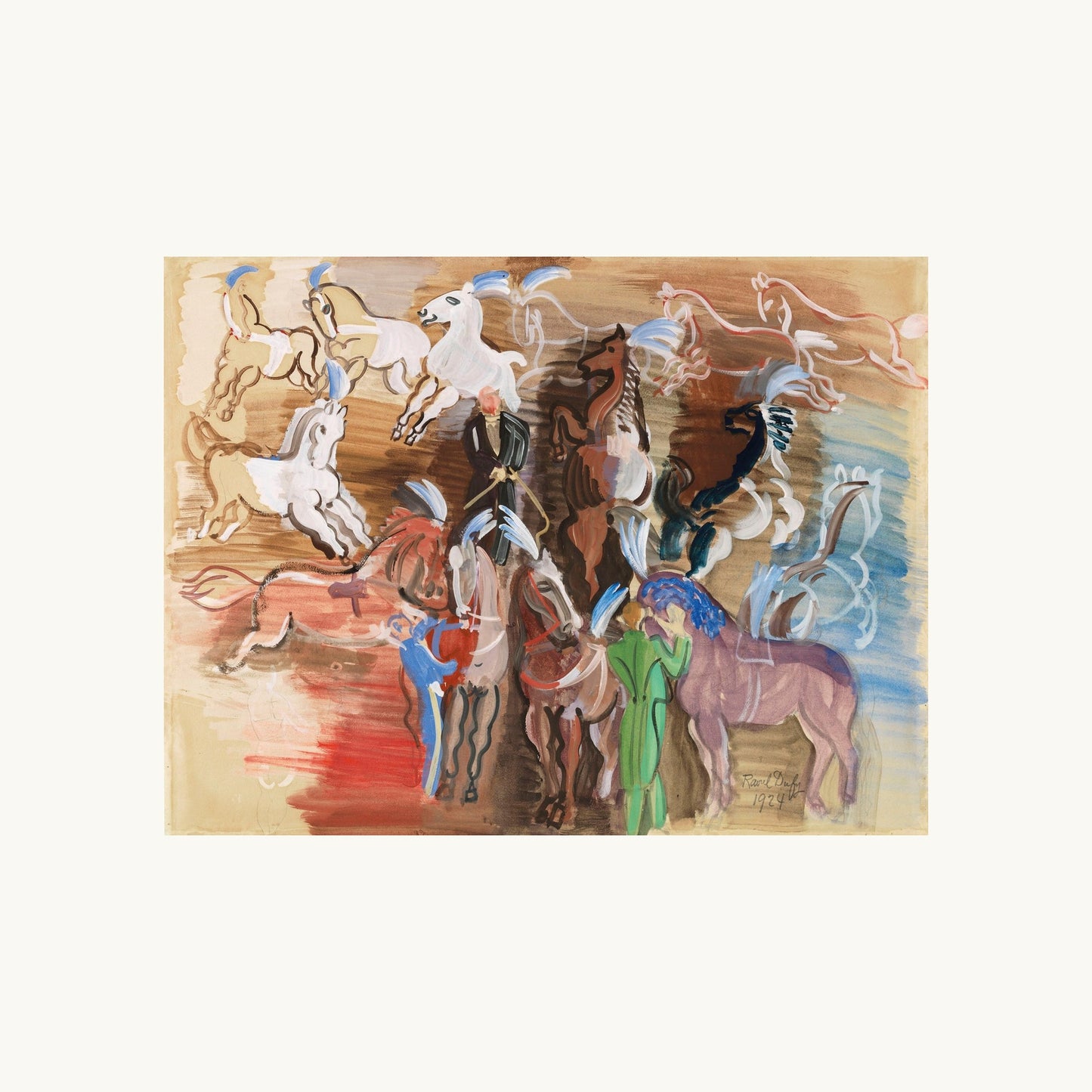
Raoul Dufy painted Chevaux de cirque in 1924, in gouache over pochoir on toned paper. Dufy grew up in Le Havre alongside Othon Friesz — they studied together, moved to Paris together, and both passed through Fauvism before going in very different directions. By the 1920s Dufy had developed the loose, fast style he's best known for, applying thin washes of color over quick drawing in a technique sometimes called stenographic. Horses and handlers fill the composition in a tumble of white, brown, pink, and blue, with a ringmaster planted in the center. The circus was a major subject for Parisian painters from Toulouse-Lautrec onward, and Dufy painted it repeatedly — other versions are now in the National Gallery in Washington and the Centre Pompidou.


See Also
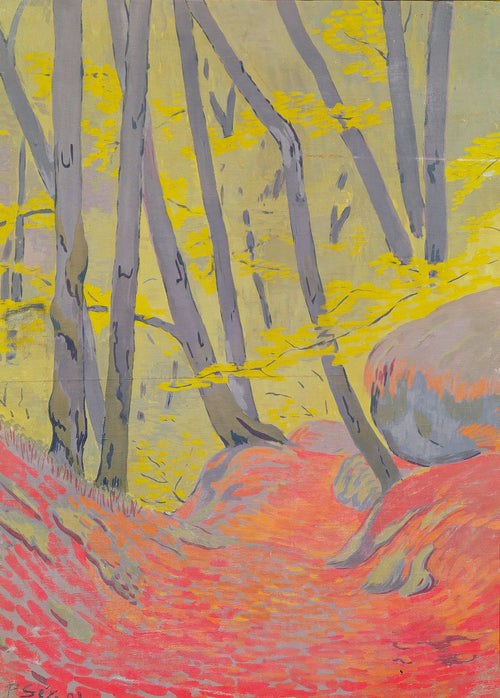
Undergrowth
Paul Sérusier
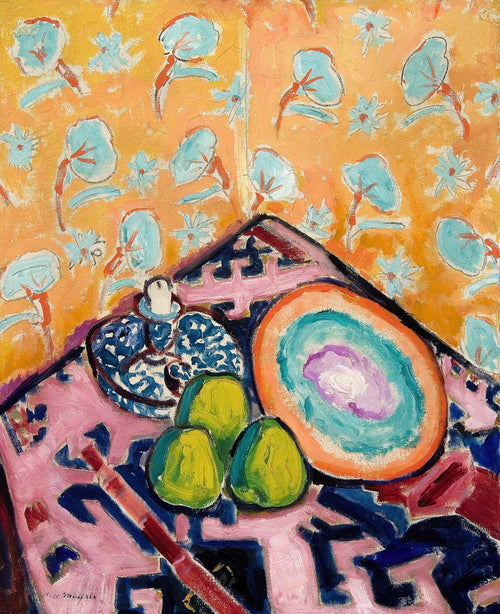
Still Life
Alfred Henry Maurer
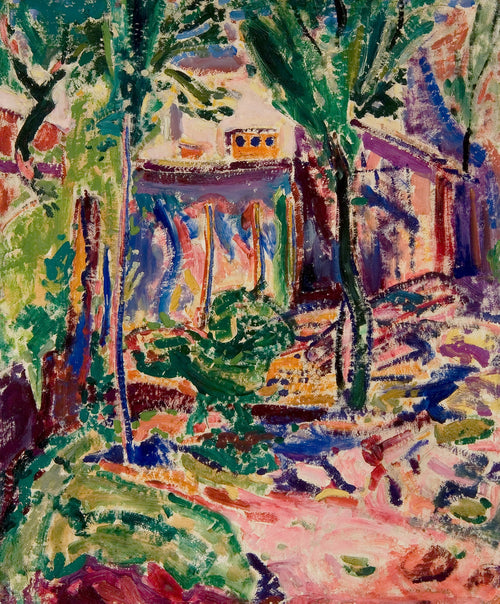
Landscape with House
Alfred Henry Maurer
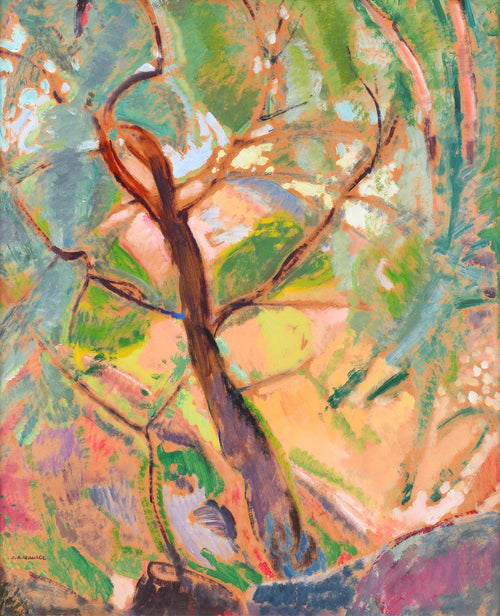
Landscape I
Alfred Henry Maurer
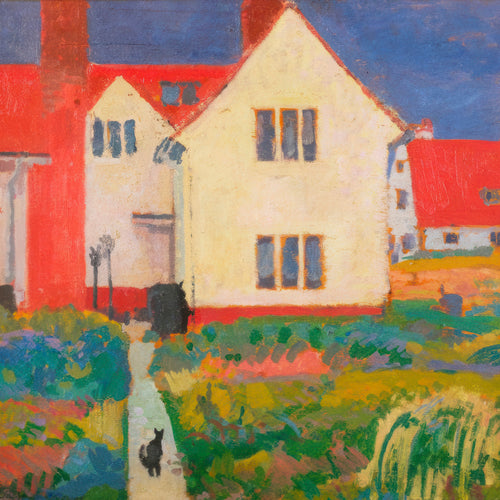
Harold Gilman's House at Letchworth
Spencer Gore
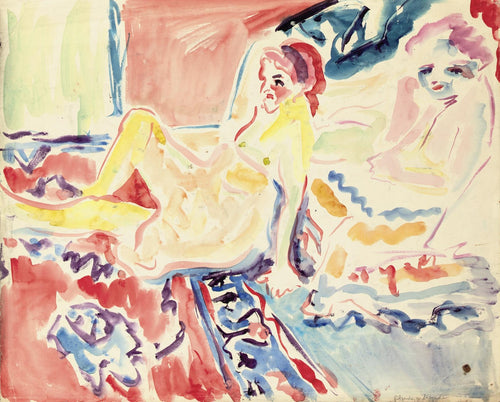
Seated and Reclining
Ernst Ludwig Kirchner
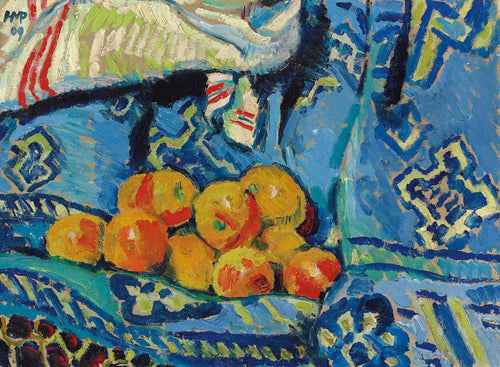
Stilleben
Max Pechstein
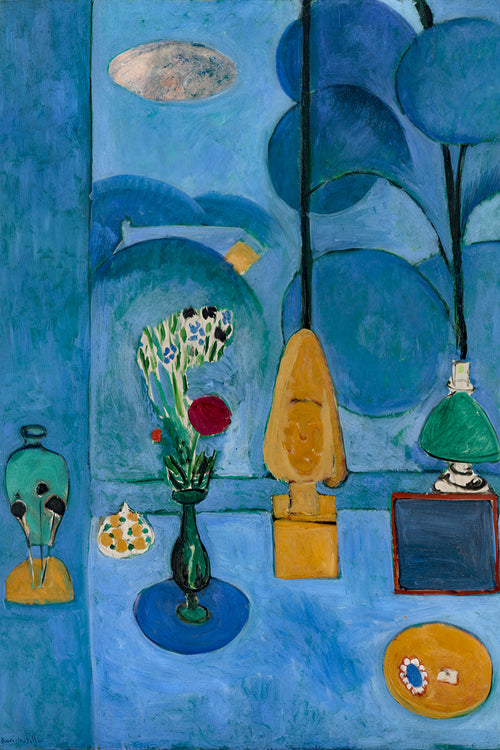
The Blue Window
Henri Matisse
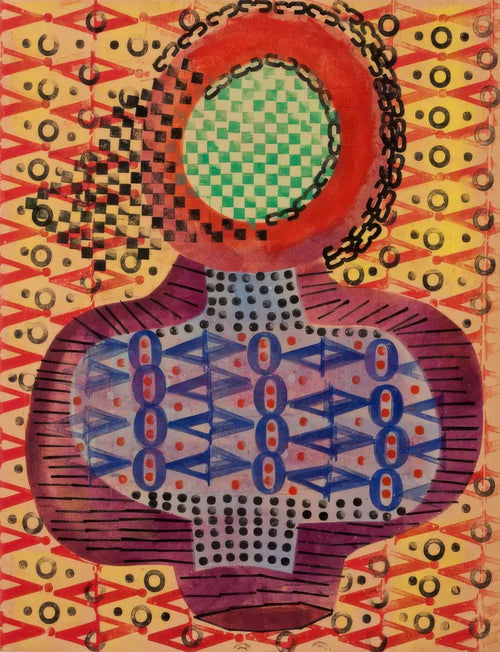
Composition (1938)
Hendrik Nicolaas Werkman
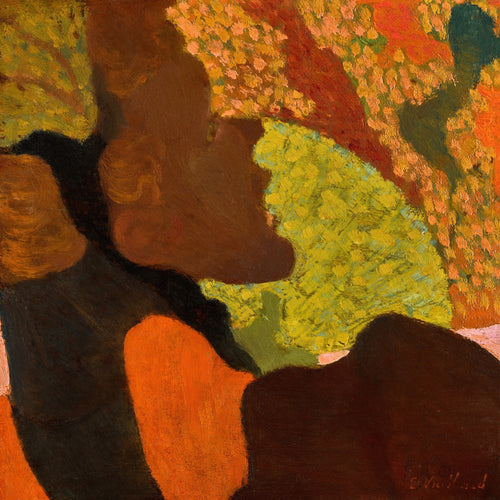
Au 'Divan Japonais'
Édouard Vuillard

La gavotte
André Derain

Untitled Sketch
Arthur Dove

Vétheuil
Raoul Dufy

Nu renversé à la draperie
Raoul Dufy

Bouquets aux amaryllis
Raoul Dufy

La chambre à Nice
Raoul Dufy

Atelier au torse
Raoul Dufy

Still Life
Edvard Weie

Vernet (Provençal Landscape)
James Dickson Innes

Arenig Fawr, North Wales
James Dickson Innes

Evening, Sun Setting behind Arenig Fach
James Dickson Innes

Still Life of Fruit and a Bronze Statue
Henri Matisse

Red Interior, Still Life on a Blue Table
Henri Matisse

The Birth of Eve
Maurice Denis

Physallis, vase bleu et pommes
Louis Valtat

Seated Female Nude
William H. Johnson

Portrait
William H. Johnson

Portrait of a Woman in a Rocking Chair
William H. Johnson

Le Champ d'avoine
Raoul Dufy

Le Bouquet d'arums
Raoul Dufy

Der Schauspieler
Jankel Adler

Abstract Composition
Jankel Adler

Komposition (1925–1930)
Adolf Hölzel

Coquelicots et fleurs blanches
Louis Valtat

L'Atelier Rouge
Henri Matisse

Bouquet de Tulipes
Suzanne Valadon

Überbrückung
Paul Klee

Variation
Alexej von Jawlensky

The Island Garden
Childe Hassam

Movement of Vaulted Chambers
Paul Klee

Farbstudien, 10 Blätter VIII
Karl Wiener

Still Life with Roses and Lemons
Józef Pankiewicz

Nu à la Fenêtre
Henri Matisse

Landscape at Collioure
Henri Matisse

Organ Chord
Marek Włodarski

Untitled (Textile Design No. VI)
Frances Hodgkins

Solva (Fishing Village in Pembrokeshire)
Frances Hodgkins

Grüne Frau mit gelbem Hut I
Hermann Stenner

Heuschrecken (Komposition)
Christian Rohlfs

Sonnenblumen
Christian Rohlfs
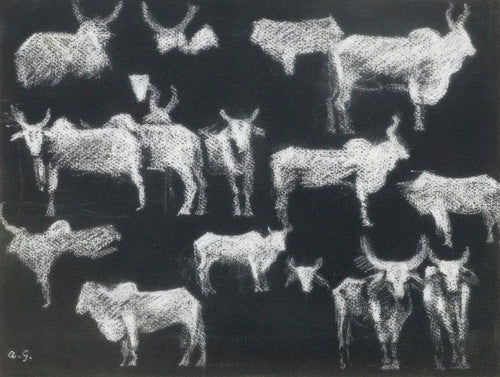
Zebus
Augusto Giacometti

Landscape from Turne
Ľudovít Čordák

The Channel Sketchbook, Folio 14
J.M.W. Turner
Still Life
Alfred Henry Maurer
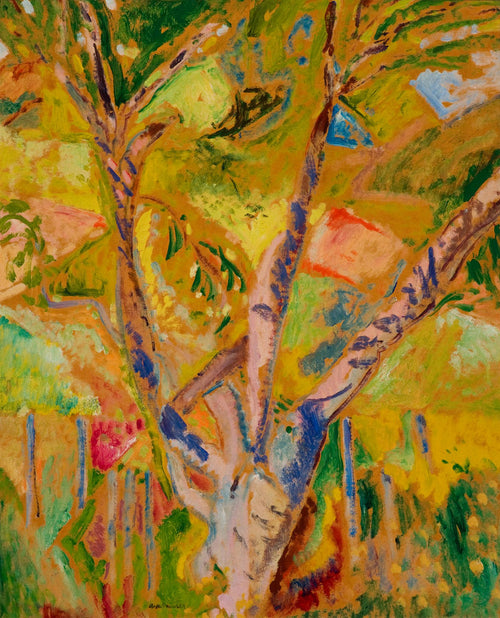
Landscape of Provence
Alfred Henry Maurer
Landscape with House
Alfred Henry Maurer
Landscape I
Alfred Henry Maurer
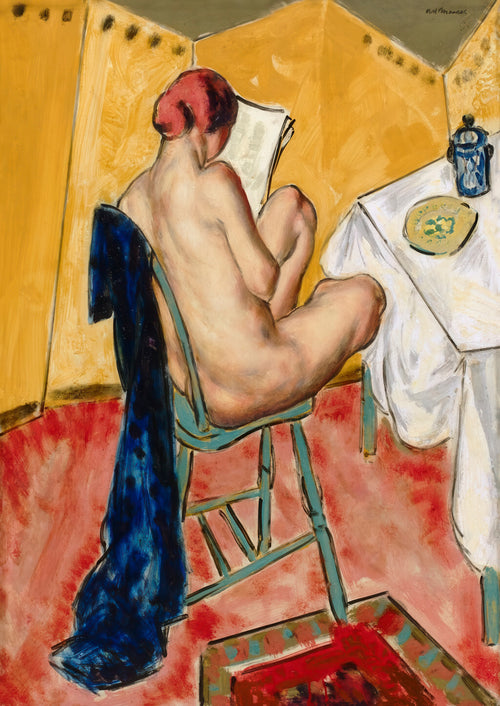
The Yellow Screen
Alfred Henry Maurer
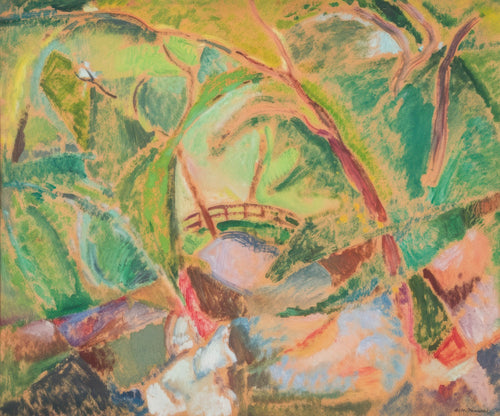
The Bridge
Alfred Henry Maurer
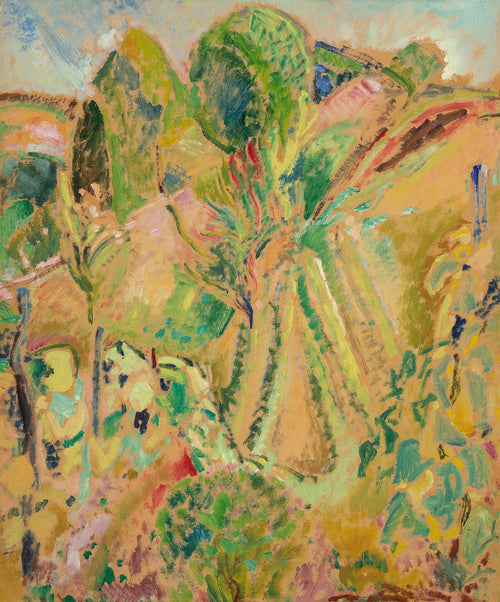
Landscape with Trees
Alfred Henry Maurer
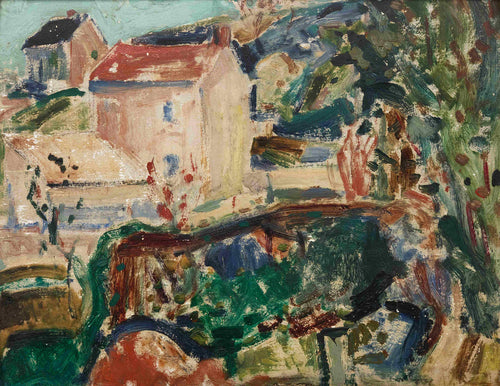
Landscape IV
Alfred Henry Maurer
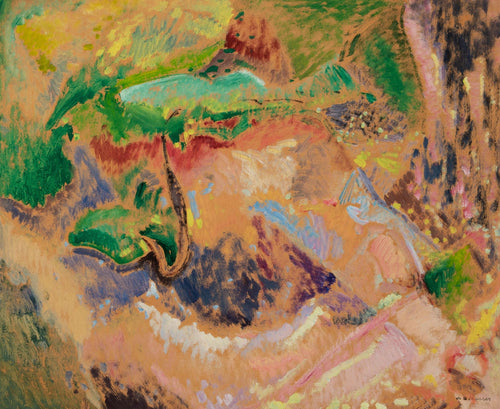
Landscape V
Alfred Henry Maurer
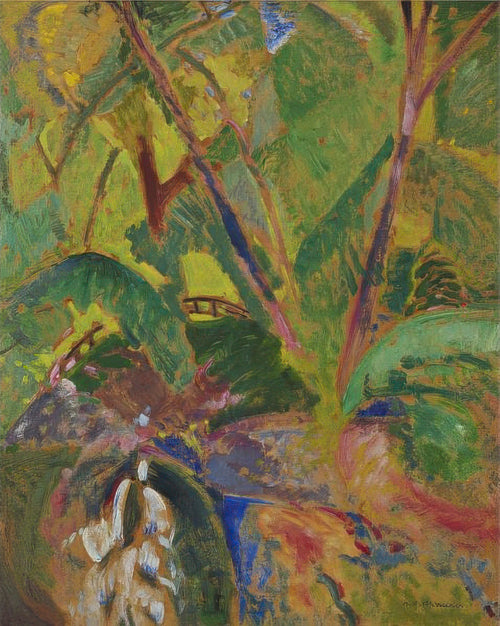
Landscape II
Alfred Henry Maurer
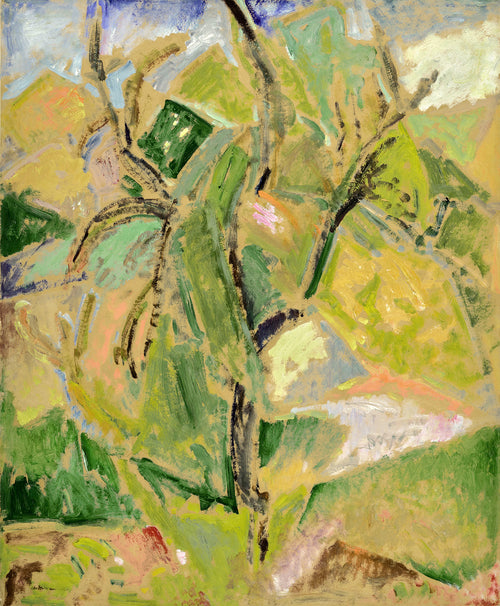
Fauvist Landscape
Alfred Henry Maurer
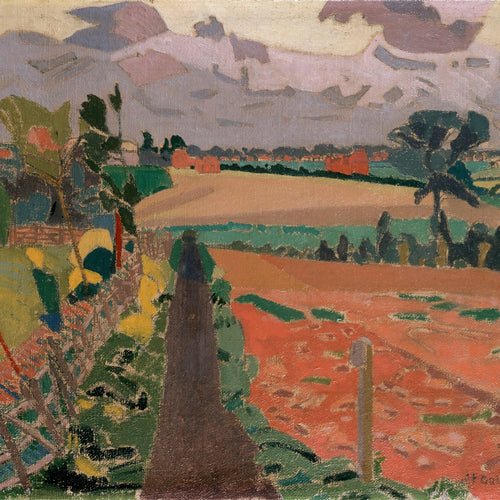
The Cinder Path
Spencer Gore
Seated and Reclining
Ernst Ludwig Kirchner
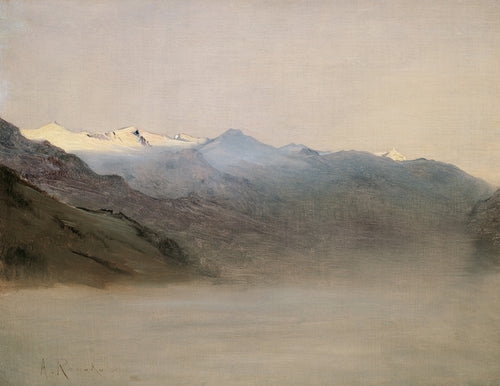
Das Gasteinertal im Nebel
Anton Romako
Au 'Divan Japonais'
Édouard Vuillard

Fauna and Nymphs
André Derain

Paysage de l'Île-de-France
André Derain

Statuaire
Édouard Vuillard
Vernet (Provençal Landscape)
James Dickson Innes

Pembroke Coast
James Dickson Innes
Arenig Fawr, North Wales
James Dickson Innes
Evening, Sun Setting behind Arenig Fach
James Dickson Innes

The Lure of the Chase
Arthur B. Davies

On the Cliffs
Arthur B. Davies

Landscape with Trees
Arthur B. Davies

Woodland Interior
Arthur B. Davies

Dew Drops
Arthur B. Davies

End of the century, 31 December 1899
Jacek Malczewski

From Jerusalem
John Singer Sargent

Birch Trees
Alois Kalvoda

The Judgement of Paris
Paul Altherr

Flamingos
Paul Altherr

The Gathering
Maurice Denis
The Birth of Eve
Maurice Denis

The Orange Christ
Maurice Denis

Matin de Pâques, aux grands arbres
Maurice Denis

Les Jardins D’armide, Esquisse
Maurice Denis

Jardin sous la neige
Maurice Denis

Fresques de Luini, à Lugano
Maurice Denis
Physallis, vase bleu et pommes
Louis Valtat

Barques et voiliers à Ouistreham
Louis Valtat

Bathing Men
Kuno Veeber

Riiul toas
Karin Luts

Three Black Horses
Leo Gestel

Storm
Eugène Laermans

Laziness
Ramon Casas

Tired
Ramon Casas


Our Process
Every piece in the archive goes through a deliberate process — part historian, part designer, part obsessive.
The thrill of the hunt
We pull from institutional archives, digitized collections, and the deep corners of the art world to find pieces that are both culturally and visually relevent, yet underexplored. We skip the hyper trendy pieces (looking at you, Matisse cutouts) in favor of niche work with a good story.
Context is everything
We dig into the provenance, history, and context around each piece — the artist, the period, the story that makes it worth living with. You don't have to be an art historian to appreciate knowing the who/what/why of a work of art, and it makes it that much more satisfying to live with every day.
Where a scan becomes a print
Institutional scans are often remarkable, but they're also imperfect: color casts from old photography, dust and scratches from the scanning bed, compression artifacts, uneven lighting across a large canvas. What we don't touch is the painting itself — the craquelure, the patina, the brushwork, the small marks of time that make a 200-year-old work look 200 years old. We restore the photograph of the painting, not the painting.
A careful eye
Color is adjusted with restraint. We reference historical materials when possible and avoid over-saturation or heavy-handed edits. The aim is a result that feels balanced, natural, and consistent with how the work was intended to be seen.
We don't do guesswork
Each piece is reviewed at print size to ensure clarity, contrast, and overall quality. Small issues become obvious at scale, so we take the time to catch them before anything is produced.


Common Questions
Giclée (zhee-clay) is a fine art printing process using archival pigment inks on museum-quality paper. The colors are richer, the detail is sharper, and the prints are rated to last 100+ years without fading. It's the same method used by galleries and museums for exhibition-quality reproductions.
All unframed prints are produced on heavyweight, acid-free fine art paper with a subtle matte finish.
Check the size guide on the Print + Frame guide page — it shows all available sizes to scale. General rule: go bigger than you think. For above a sofa, you want the art to be about two-thirds the width of the furniture below it.
Some cropping may occur depending on the aspect ratio of the original artwork and the size you select. Each size is adjusted differently—some preserve more of the original image, while others require a closer crop. We use our expertise to crop each piece in a way that maintains the integrity of the composition.
Our preview tool above gives a general sense of how the piece will look at different sizes, but it crops from the center and may not reflect the final composition exactly. If you’d like to confirm how a specific size will be cropped, feel free to reach out—we’re happy to help.
Our frames are solid oak or metal with a clean, modern profile. Oak frames are available in Natural Oak, Walnut, Black, and White. Metal frames are available in Gold, Silver, White, and Black. Matted options use an acid-free mat with a standard reveal. Every framed print arrives ready to hang. For frame dimensions and specs, please see our Print + Frame guide page.
Framed prints come with hanging hardware attached. Use two picture hooks for anything 18×24 or larger for the most secure hold. For unframed prints, we recommend taking them to a local frame shop — they'll cut a mat and mount it properly.
Orders are printed to order and typically ship within 3–5 business days. Delivery within the continental US usually takes an additional 3–4 business days.
We currently ship unframed prints internationally. Framed prints are only available within the US.
Reach out within 14 days and we'll take care of it. Please see our Shipping + Returns page for more information.
Because every print is made to order, we can't accept returns or exchanges. If you're unsure about sizing, check the size guide on the Framing page or get in touch — we're happy to help you decide before you buy.